Wednesday, May 30, 2012

Coffee and Eccles Cakes - with Miss Read

(This was published over at my main blog, A Brickworks Looks At Life. Thought you might enjoy it, too!)

If you're drinking coffee, you're apt to live longer. 
The National Institute of Health and AARP's recent study of 400,000 is the largest ever...and surprised the pants off researchers, who expected to show that coffee was the Ever-Growing Kiss of Death. Earlier studies had suggested that coffee raised LDL levels ('bad' cholesterol), as well as blood pressure short-term...and those combined do pose a risk of heart disease.
     "Even in the new study," according to the Associated Press article by Marilynn Marchione, "it seemed coffee drinkers were more likely to die at any given time. But they also tended to smoke, drink more alcohol, eat more red meat and exercise less than people who don't drink coffee. Once that was taken into account, a clear pattern emerged: Each cup of coffee per day [caffeine or no caffeine] nudged up the chances of living longer."
     They just don't know why. (See the report here.)

While trying to face the day, first cup of coffee in hand, I enjoy a dip now and then in Miss Read's books. Miss Read, in case you're unfamiliar with her, has a whole English countryside of several towns, and vivid characters, waiting to meet you. They're "cosies," snippets and tidbits of these people's activities all year round -- and a refreshing change from your own. Her Christmas stories are unparalleled, too. (The nearest I can get, American-wise, is Jan Karon's work.)
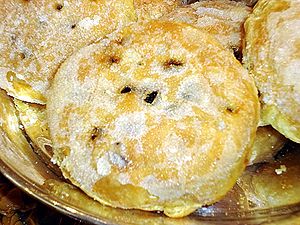
   Anyhow, Miss Read's people love to add baked goods to their tea and coffee, including something called 'eccles cakes.' Wikipedia defines them as  "a small, round cake filled with currants and made from flaky pastry with butter, which is sometimes topped with demerara sugar." They seem to be something like a date-filled or fruitcake cookie. (The Mama makes a sugar cookie filled with ground raisins that seem to be like these. Looks more like a pancake in the photos, but you eat them out of hand.) Some sources say they're similar to the Banbury cakes of the nursery rhyme...but that doesn't help us Yanks much.
   Here's what the Salford City Council, home of the Eccles cake, says about it:

In 1793 James Birch’s shop on the corner of Vicarage Road in Eccles began selling small, flat, raisin-filled cakes. They sold, quite literally, like hot cakes!
Earlier, in 1769, Mrs Elizabeth Raffald, the housekeeper and owner of a confectioner’s shop in Arley Hall, Cheshire, wrote an influential cookery book, "The Experienced English HousekeeperExternal site" which became a best seller. The book contained a recipe for "sweet patties" with ingredients identifiably similar to the Eccles cakes of today. Could this have been the recipe seized upon by a cookery-mad servant girl who took a copy of the book with her when she went to live in ... Eccles?
Whatever the murky origins of the cakes, James Birch was certainly the first person credited with selling them on a commercial basis...
     Whether James Birch made a name for his cakes in the 1780s, in 1796, or indeed some time later, is now impossible to say. It is equally impossible to construct a link between James Birch and Elizabeth Raffald (who died four years before the opening of Birch’s shop).
More recently the question of origin of Eccles Cakes has been raised in Parliament. A question was tabled regarding the future of cakes made outside Eccles to the same ingredients. Could non Eccles-made cakes still be referred to (and sold) as Eccles cakes?

 How many cakes, cookies or cupcakes do we know that are worthy of being debated in Congress?? Back to the story:

Throughout history, families making Eccles and (the similar) Banbury cakes have all kept their recipes as closely guarded secrets. One of the most famous expressions in Eccles is "The secret dies with me!".
The authors of cookery books would therefore have had to invent their own recipes based on the taste of the cakes they purchased at different shops. 17th Century recipes for Banbury cakes do exist but show that they differ from 19th Century ones. A major difference was the use of yeast which was necessary before the introduction of raising agents.
Although no 18th Century and only a few 19th Century cookery books give recipes specifically for Eccles cakes, it may well be that early ones differ from those known today.
Mrs Raffald’s original recipe for "sweet patties" of 1769 was a mixture of the meat of a boiled calf’s foot (gelatine), plus apples, oranges, nutmeg, egg yolk, currants and French brandy enveloped in a good puff pastry which could be either fried or baked. The use of the word "meat" [or "mincemeat"] in the early recipes serves as a reminder that meat was originally an ingredient in mincemeat.
The fact that Eccles cakes were being exported by 1818 also suggests very good keeping qualities, so they may well have included spirits such as brandy and rum. No wonder the Puritans wanted to ban them.

Well, gee. I'd better go dig that calf's foot out of the freezer, and resurrect the French brandy -- or maybe I'll just use the modern recipe below. Surprise your family with this venerable goodie, or have one yourself, preferably while reading something by Miss Read. (I'd recommend Village School or Christmas Tales, for starters, or the first one I ever read -- Mrs. Pringle.)

ECCLES CAKES (courtesy of the Salford City Council)

  • 1lb 2oz/ 500g puff pastry
  • 1oz/ 25g butter, melted
  • Pinch freshly ground nutmeg
  • 2 oz/55g candied peel
  • 4 oz/ 110g sugar
  • 8 oz/ 225g currants

Preparation:

Pre-heat oven to 425°/220°C/Gas 7
  • In a medium saucepan, combine the sugar and butter and cook over a medium heat until melted.
  • Off the heat, add currants, candied peel and nutmeg.
  • On a lightly-floured surface, roll the pastry thinly and cut into rounds of about ¼ inch/0.5cm thickness and 4 inch/10cm diameter.
  • Place a small spoonful of filling onto center of each pastry circle.
  • Dampen the edges of the pastry with a little cold water and draw the edges together over the fruit and pinch to seal.
  • Turn over the patty over, then press gently with a rolling pin to flatten the cakes. Snip a V in the top with scissors. Place on a greased baking tray.
  • Brush with water and sprinkle with a little extra sugar.
  • Bake in the preheated oven for 15 minutes or until lightly browned round the edges.
  • Place on a wire rack and allow to cool.Try not to eat them all at once!


Update: While researching this, I discovered Miss Read, aka Dora Saint, died back on April 7 -- just 10 days short of her 99th birthday. She may not have had the notoriety of a Robert Ludlum or Clive Cussler...but her books were never out of print. Reading them, I felt as if I were talking to an old and trusted friend. Take a look at her obituary for more. Her bibliography is here.
   Rest in peace, Miss Read. We will miss you.


Sunday, May 27, 2012

Happy Memorial Day!


THANK YOU to those soldiers and patriots, past, present and future, who honor our country with their lives and their commitment.

We appreciate it so much.

Have a great, restful weekend.

Friday, April 20, 2012

Flat-Broke Food: The Grand Finale

By now, you've worked your way through a week's worth of foods that are a triple threat: frugal, easy to make and most of all -- tasty. Need more ideas? You'll find my personal list on the Brickworks blog: A Dozen Frugal Cookbooks You've Never Heard Of (Plus Two You Have). There are many more dishes out there to try, especially in cookbooks that detail other countries' cuisines. Thanks to a Denver restaurant, New Saigon, I've been inspired to fool around with Vietnamese food (lighter, spicier, lots of fresh veggies.). Thai food is also on my culinary horizon, after some preliminary messing around with curries and Thai noodles. Oh, the burden of getting to cook delicious, interesting food! (limp hand to forehead)

Enjoy the journey. We'll be back with more recipes and ideas around May Day, then will present a Week of Barbecue just in time for Memorial Day weekend. Come on back and visit -- or better yet, sign up to 'follow' or subscribe to e-mail, so you don't miss a single, succulent bite.


Flat-Broke Food: Whacky Cake!

I hope you've been enjoying this week of frugal food. Many of these recipes are from our cultural past -- it may confuse us sometimes, but Americans have been very fortunate to be able to choose from so many cultures for our food and pastimes. How could our country have gotten so far, without all these different contributions to the cultural pot? The answer is -- we couldn't.

The last in this particular batch is a cake that grew out of shortages, particularly WWII and the Depression. Eggs were not always obtainable, unless you lived on a farm; milk could also be scarce. And much of the country's snacks, including chocolate, went to the troops.
    Enter a moist, chocolaty cake that undoubtedly emerged out of desperation from some housewife's creative mind. It takes less than ten minutes to stir up -- and it can be mixed right in the pan. (She must have been busy.) Either her pantry was empty, or she was just 'out:' this cake uses no eggs -- milk -- butter -- chocolate chips. And it's low in fat. (Take note -- great for vegans, those watching their weight, or people with allergies.) 
     The magic ingredients: cocoa -- and vinegar!

WHACKY CAKE
1 cup sugar
1 1/2 cups flour
3 tablespoons cocoa
1 teaspoon soda
1/2 teaspoon salt
1 tablespoon vinegar
1 teaspoon vanilla
6 tablespoons oil (1/4 cup, plus one tablespoon -- I use olive oil)
1 cup water

Set your oven to 350 degrees. Pour the dry ingredients into a 8" square or round pan -- mix, and shape three wells in the dry stuff. (You can also mix in a bowl.) Pour the liquid ingredients in, water last, and quickly mix. Bake for 30 min., or until a toothpick is dry when inserted in the center.
    This recipe can be easily doubled for a 9x 13 pan or bundt/angel food cake pan; it may take up to 45 min. to bake.

This cake is tasty served as-is, or with a sprinkle of powdered sugar. Or, for you spendthrifts out there who can afford butter and cream (!!!), add an easy frosting. It's very similar to that used for German chocolate cake.

FAST & EASY ICING
1/3 cup softened butter or margaine
2/3 cup brown sugar
1/4 cup cream
1/2 cup chopped nuts
1/2 cup coconut

Mix butter, sugar and cream together; add nuts and coconut. Frost your cake while it's still warm. Watch your guests gobble it down...and smile to yourself.

Thursday, April 19, 2012

Flat-Broke Food: Chowder en Pisces

Fish-head stew. It's what Charlie's mom served in the movie Chaplin, when they were dead broke and about to get thrown out of their flat. Fish heads are certainly cheap: I just saw salmon heads at our local Vietnamese fish market for less than $1 a pound. (And salmon is running about $8-12/lb around here in Colorado -- $5.99/lb on sale.) 
    But can they be tasty?
    Yes -- if you follow a few standard rules. First, get them as fresh as possible. Next, look for the biggest heads you can find -- like salmon or sturgeon. (Salmon cheeks are actually considered a delicacy!) Ask the meat department clerk at your local grocery store. They may be discarding the heads when they process fish, and will be glad to sell them cheap -- or even give them away.
   Finally, cook them first to remove the meat: scrub the heads in warm water with a little vinegar, cover with fresh boiling water, and gently simmer until the meat is firm and flakes easily. Pull the meat off, and use it in your favorite recipe. (Discard any fat - it's what gives it that fishy taste -- preferably to your dog or cat!)
     Once it cools, pour out the cooking water on any plants that could use the extra nutrients. The bones can be buried near plants, as well.

This fish is wonderful in pasta or a casserole. Or try it in a chowder, like this 'receet' inspired by one in Stories and Recipes from the Great Depression of the 1930s, Vol. III, by Rita Van Amber.

STURGEON HEAD CHOWDER
approx. 2-4 pounds meat from larger fish heads
           (Two sturgeon heads will give you about 3-4 pounds meat. Substitute 2-3 pounds salmon heads, if you prefer, or other fish heads. Prepare the heads first, using the instructions above. If you think this will bother your guests or family, tell them after the meal -- or not at all. This is our secret.)

6-10 cups chicken broth
     (or use water and 5 chicken bouillon cubes. 
          A few cups of meat gravy, plus water, can be substituted)
5-8 potatoes
1 onion
3 carrots

3 tablespoons flour
1 cup milk 

Start the broth; while it's heating, dice the meat and chop the vegetables. Dump everything into the simmering broth, and let cook for about 30-45 min. (Or 3-4 hours on low in a crockpot.) Add more water as needed to keep it at soup consistency.
     Mix flour in milk, pour it in and stir until the soup thickens. "Do not boil after you add the milk mixture; keep it just below the boiling point. Salt to taste and add all the pepper your family can enjoy. I like it to warm me as it goes down..."
     (thanks to Carl Holland for his contribution. Serves from 4-8)


Flat-Broke Food: Emergency Pantry

 We all hit times when things are looking a tad sparse in the food department. That's not so bad -- for one thing, it means that you're cycling through your food supplies without wasting much. For another, it gives you a fresh place to start from.


First, figure out what you've got. Check the frig -- freezer -- shelves.

Second, tidy up. This is a perfect chance to wipe down shelves and scrub out the veggie crisper. Your kitchen will look and smell better for it. (While you're at it, scrub the floor, too. Makes you feel very efficient.)

Now you're ready. Begin with the basics. Eggs, butter, milk and flour can make pancakes and bread. Biscuits are not difficult, either. Olive oil is healthier than many other types, and can be used in a variety of ways. Popcorn (great for snacks), oatmeal, dry beans (pintos are cheapest around here) and rice keep a long time -- buy them in as large a package as you can afford. (Noodles are good, but can be made by hand. Buy macaroni or pasta instead, if your money is tight.) Add brown and white sugar, baking powder/soda and salt, and you've got a solid start.
     Coffee and tea are nice to have around, as well -- but if need be, you can wait on those. Grinding your own coffee beans gives a fresher taste, and using a 'British-style' tea (we Americans are such wimps in this department) gives you a stronger cup.

Next, add as few or many spices as you can afford. Dried onion and garlic flavor any dish nicely. I also rely on cinnamon, nutmeg, marjoram, basil, oregano (look for a good Italian blend, if you prefer), curry and chili powder, mustard. A bottle of hot sauce is a must; add bottles of ketchup, barbecue sauce, steak or Worcestershire sauce when you can, as well as a jar of onion soup mix. (Dole the latter out sparingly to zip up homemade soup, or add a tablespoonful to your meatloaf.)

Now look at what fresh vegetables you can afford. Root veggies, like onions, carrots and potatoes, are a standard, and generally cheaper than the others. (Tip: buy a bunch of green onions, if the larger ones are expensive -- they'll flavor your food nicely, and add color.) A bunch of spinach not only will serve for salads, but is good chopped into soup, stews or casseroles. For fruit -- what's on sale? If nothing looks appealing (or cheap enough), bananas are usually the next option. (Don't forget canned peaches, pears, oranges, either.)

And finally on the list: a loaf of bread, corn and flour tortillas.  Crackers, if you can. A few extra cans of vegetables, corned beef hash, soups, etc. will fill out your cupboard and give you quick meals at short notice.

The ten things I think should always be in a pantry? I'd add these, too.

This basic pantry can help you head in all sorts of culinary directions, at surprisingly little cost.

Flat-Broke Food: Scraping Bottom - Kratser, Schmorn and Toad In The Hole

Desperate for food? There aren't many of us at that point. Fortunately, soup kitchens and food pantries are a help for people who honestly don't know where their next meal is coming from. During the terrible Thirties and Forties of the Great Depression, a lot more had that uncertainty to deal with.

Some of their recipes can help you stretch basic ingredients even further.

Take Schmorn, for example. This all-in-one skillet pancake was a staple for families then, and is still a great basic breakfast. And all you need is milk, eggs and flour. P.S. It also can use up leftover breadcrumbs.

SCHMORN 
(also known as Schmarren or Kratser)
   "It can be made from any number of eggs, a little more milk than you'd use for scrambled eggs, a little sugar, salt and powder and enough flour to make a thin batter, like a very thin pancake batter. [Mom] fried it in butter in a hot black iron skillet, stirring and turning it until it was a golden brown.
   "My husband's mother made it by adding bread crumbs to the egg-milk mixture, with a pinch of salt, sugar and no baking powder, until all liquid is absorbed."
           (Julie Weiss)

   'The mother of a Whitehall lady' gave another version: "My  mother heated 2 cups of milk, broke up dry bread, as much as could be absorbed and poured three or four beaten eggs with salt and pepper and a pinch of sugar and fried it in a pan. Good!"


These recipes resemble 'Dutch Baby' pancakes. Use a little meat, and your 'Kratser' comes closer to the traditional Yorkshire pudding.

KRATSER
"These dishes were made many times a week and the families never tired of them."

"Fry bacon cut into small pieces. Pour over it a batter made of 3 eggs, 1/2 cup milk and 1/2 cup flour and seasoning. Stir and turn until it is a gold brown, like omelets. Pork cracklings were also used in this dish."
  (all recipes are from Stories and Recipes of the Great Depression of the 1930's by Janet Van Amber Paske)

One supper dish my family loves uses the same Yorkshire pudding/popover-type batter -- but with sausages. It's called, aptly:

TOAD IN THE HOLE
  • 1-2 teaspoons butter or margarine
  • 3/4 cup all-purpose flour
  • 1/2 teaspoon salt
  • 3 eggs
  • 3/4 cup milk 
*1/2 - 1 pound sausages

Turn the oven to 450 degrees, put the butter in a 9" square or round baking dish, and heat it until the butter is melted. In the meantime, quickly stir the other ingredients together. (Speed is important here.)  Pour the batter into the hot pan, and drop in one larger sausage for each person, or 2-3 breakfast sausages. (They will 'peek' out of the batter as it bakes around them.) Bake 15-20 minutes, until the mixture is set and dry on top. Serve right away for up to 4 people